Do You Want to Be Right, or Do You Want to Play?
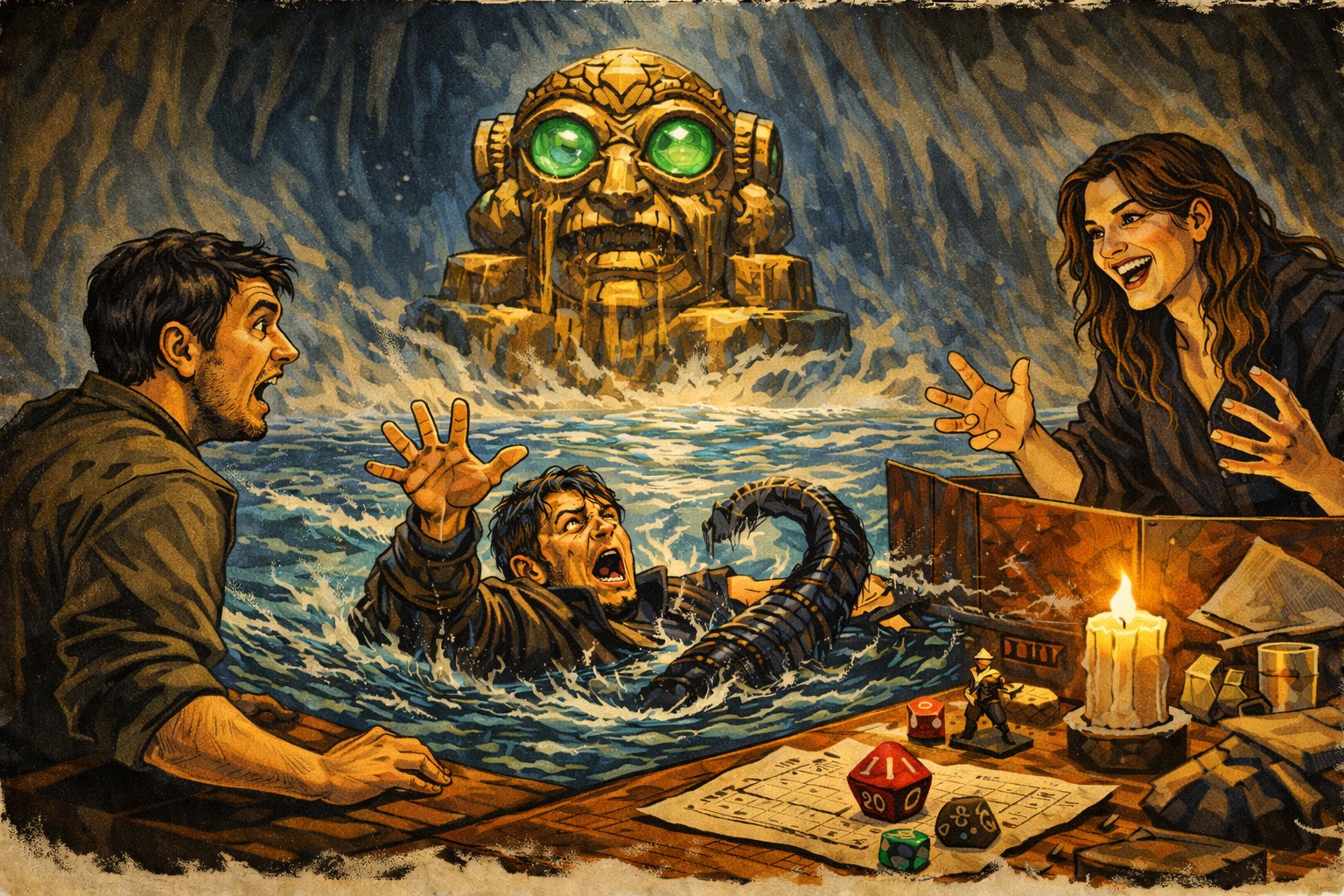
It’s game night. Your players are leaning forward as you describe the predicament Jonas, the party’s rogue, has gotten himself into after slipping away to bag some swag without the paladin noticing.
The GM paints the scene: waist-high icy water, light playing across its surface like something alive beneath it. At the centre of the pool stands a golden idol, emeralds the size of satsumas glinting where its eyes should be.
Jonas feels something brush his foot.
He rolls Strength. He fails.
With a wicked grin, the GM announces that something has embolised him and calls for a Dexterity check. Jonas’s player rolls… respectable. Not great.
To keep the pace moving, the GM makes the call: the creature has grappled Jonas and drags him under.
That’s when the rulebook hits the table.
“Wait. That’s not how grappling works.”
Another player pulls out their phone. Someone asks what version of the rules you’re even using. Within seconds, the session dissolves into a chorus of “Well, actually…” as half-remembered house rules and YouTube rulings get summoned like lesser demons.
The idol waits.
The water stops moving.
And the game pauses.
At the table, “Being Right” isn’t villainy. It’s human.
To play any system is to live inside a small paradox. We all like to think we know our chosen ruleset inside out, yet no one would ever introduce themselves as a rules lawyer.
A rules lawyer is the player who quotes the Player’s Handbook chapter and verse but, like Inspector Javert with a dice bag, follows only the letter of the law, never its spirit. At best, they are earnest. At worst, they can twist the precise wording of a rule to suit the moment and become pernickety, disruptive, and about as much use as a gelatinous broadsword.
We all want to look competent. There is nothing that slows a game faster than a player staring at their character sheet for three full minutes in the middle of a high-stakes combat only to announce, “I attack.” But that, at least, is forgivable. We are not all scholars of every system.
The real trouble begins when the table shifts from storytelling to scorekeeping.
In a debate, there is a winner and a loser. That mindset works beautifully in debating societies.
But TTRPGs are not debates.
They are collaborative storytelling. The point is not to win an argument. It is to tell the story of how your particular band of misfits overcame the odds and stood triumphant over the villain.
At the gaming table, an insistence on being right is not just disruptive.
It can be poison.
Why Zero-Sum Thinking Erodes Trust
Roleplaying is not a zero-sum game.
A zero-sum game is something like poker. There is a clear winner and a clear loser. If I win, you lose. If I lose, you win. There is no version of events where both parties walk away victorious.
Roleplaying is not poker.
It is a cooperative storytelling engine disguised as a rules system.
One of my non-roleplaying friends once asked me, “How do you win at Dungeons & Dragons?”
There are plenty of answers. You can go philosophical: You don’t win. You just get a little better every time.
You can go almost Zen: The goal isn’t to win. The goal is to keep the game going.
But in truth, there is no single way to “win” a roleplaying game.
Because the moment someone tries to win at the table, something subtle shifts.
Take poor Jonas, flailing in that icy pool. If his player pushes to win the rules argument, what actually happens?
The GM feels challenged.
The other players feel sidelined.
The fiction stalls.
The tension drains.
The table moves from imagination to adjudication.
And the unspoken message underneath the argument becomes:
My being right matters more than our shared momentum.
That is the fracture point.
That is where trust starts to thin.
The GM loses their thread. The players check their phones. The energy curdles. In the worst cases, campaigns quietly die not because of dragons, demons, or scheduling conflicts, but because the table stopped feeling collaborative.
At the gaming table, the real currency is trust.
Trust that if the GM makes a snap ruling, it is in service of pacing.
Trust that if a player raises a concern, it is in service of fairness, not ego.
Trust that everyone is pulling in the same direction.
Almost every RPG rulebook contains some version of a golden rule: the rules exist to support play, not replace it. Or more bluntly: the only real rule is to have fun.
You can have the most intricate, beautifully balanced ruleset ever printed. But unless everyone at the table occasionally agrees to roll with it for the sake of momentum, you do not have a story.
You have a courtroom.
Winning the Argument, Losing the Game
In an RPG, the GM should never be a tyrant.
I once had a GM who, as “punishment” for speaking out of character, reset my XP to zero. That was not table justice. That was overreach.
I have also played with people so fixated on mechanics that they forgot to inhabit a character at all. It was like adventuring beside a literal paper man. He existed only as numbers and clauses. More rollplay than roleplay.
Both extremes miss the point.
But something subtler happens when a player “wins” a rules debate.
There is a brief flash of validation. The hours spent mastering obscure interactions, edge cases, and designer commentary suddenly feel justified. Player McSmartyPaints is correct. The GM is wrong.
Zero-sum thinking strikes again.
And even if no one says it aloud, the emotional math at the table shifts.
The GM feels diminished.
The referee’s authority wobbles.
The tempo stutters.
The tension leaks out of the scene like air from a punctured tyre.
There is no XP awarded for slaying the GM.
No level-up for being technically correct.
No inspiration die for proving someone else mistaken.
What you gain in accuracy, you can easily lose in atmosphere.
And atmosphere is harder to rebuild than hit points.
How to Interrupt the Spiral
We know being right is not as important as having fun. We know pride sometimes needs to be swallowed for the sake of table harmony.
But what does that look like in practice?
How do we stop the standoff before it calcifies into friction?
For Players
1. Ask yourself: Is this worth breaking the moment for?
Most of a GM’s job is not plotting the demise of your beloved character. It is, more often, trying to stop you from accidentally unaliving yourselves by enthusiasm.
If the scene has momentum and the ruling is not egregious, consider letting it ride. A natural 20 missing entirely might warrant a pause. A slightly messy grapple interaction probably does not.
2. Phrase corrections as questions, not declarations.
There is a world of difference between:
“That’s not how grappling works.”
and
“Are we using standard grappling rules here?”
The first challenges authority.
The second invites clarification.
Tone matters. Timing matters. Delivery matters.
3. Accept now, revisit later.
You are not the only person at the table.
If a ruling genuinely bothers you, make a note. Bring it up after the session or in private. When you and the GM are back on equal footing, the conversation becomes collaborative rather than confrontational.
Momentum is easier to preserve than to rebuild.
For GMs
1. If you have a walking rulebook, use them.
If a player knows the system inside out, that is not a threat. It is a resource. Thank them. Ask them. Defer when precision genuinely matters.
Just remember what GM stands for.
You are the Game Master, not the Game Martyr.
2. Make the call. Move forward.
There is nothing wrong with a snap judgment to keep the scene alive. Make it clear that you can revisit the ruling later if needed. That reassurance preserves fairness without sacrificing pace.
3. Do not spiral.
Avoid second-guessing yourself into silence. Avoid shutting down. Games are meant to be two things: fair and fun.
If your calls are in service of those two pillars, you are doing the job. Remember, the goal is a shared story, not rules supremacy.
Somewhere in that cavern, Jonas is still flailing in the dark. The idol is still watching. The story is still waiting.
The question is simple.
Do you want to be right?
Or do you want to play?