Stat Blocks Don’t Scare Anyone: Show, Don’t Tell for Game Masters
“Don’t tell me the moon is shining; show me the glint of light on broken glass.”
— Anton Chekhov
One of the most oft-quoted bits of advice given to storytellers of all kinds is the old chestnut: “Show, don’t tell.”
What that actually means for Game Masters is that while there are certainly times when you should just cut to the chase and give your players the unvarnished facts. For example:
The ship rocks with the concussive blast of the photon torpedoes.
Or:
An arrow hits you in the arm, and it hurts like hell.
But there are also times when you need to pull back and really paint a word picture for your players. A good writer builds a world with words alone. As GMs, we do very similar tricks to coax our players into buying into the shared fiction we offer.
Showing as a GM means presenting your game through sensory details, actions, and dialogue.
Instead of merely stating a fact — the goblin looks angry — you provide evidence that leads the players to that conclusion.
The goblin’s red eyes flash with hostility as he scowls at you.
Ultimately, none of us wants to be the guy who treats a TTRPG session like a theatre kid who’s just heard there might be a talent scout hiding in the dice tray.
But emotion at the table isn’t declared.
It’s demonstrated.
If you just say “Balfore is sad about that,” it lacks the impact of actually showing us the effects of the event by roleplaying them.
When we embody our characters or NPCs, we elevate the game to another level.
This becomes even more important when playing remotely — over Discord, for example — where the other players can’t see your body language. In those situations, leaning into detail can really help bring out the emotional core of a scene.
I’m not saying you should arrive with long, purple-prose monologues prepared in advance. Sometimes brevity is your friend. Sometimes naming the emotion is enough.
But remember:
We don’t feel labels.
We feel details.
Labels vs Signals
Telling is when you simply name the emotion.
The dragon looks angry.
Balfore feels scared.
My character hates him.
There’s nothing inherently wrong with this. Sometimes speed matters more than nuance.
But there are moments where you can do more.
Instead of saying:
“I can’t stand that NPC.”
Try something like:
“My eyes never quite meet theirs when they speak.”
Or:
“Grinding my teeth, I hold the goblet tight enough that it cracks.”
You can have fun with this too, building quirks and nuance into your character. Maybe they feel uneasy, so they wipe their hands on their cloak before shaking someone’s hand.
These signals work because they give the other players something to react to. They create hooks for the GM to use… I mean, exploit… and they add texture that makes your character feel more real than just a string of numbers on a character sheet.
At the table, showing isn’t about being verbose.
It’s about giving the room a handle.
The Sensory Lever
When we get lost in a good story, it’s because our minds are being guided by the author. We experience the narrative through the protagonist’s eyes, ears, and other senses. The very best writers make us feel as though we’re standing right beside them.
As Game Masters, our job is a little trickier. We have to make all of our players feel like the protagonist.
That means creating vivid, memorable mental images that go beyond simple visual description. Sensory details can evoke stronger, more realistic connections to the story or adventure.
There are several reasons to use the full range of the players’ senses.
• Immersion and realism.
Describe how a scene feels. The smell of a Drow’s perfume. The taste of bitter ale. The babble of voices in a crowded cantina. Suddenly, the game world becomes tangible.
• Emotional engagement.
By engaging the senses, you deepen the player’s emotional connection to their character. Visceral details help players feel like they are part of the quest, not just observing it.
• Richer setting detail.
A moment spent explaining why the ale in one tavern tastes better than another, or how the overlapping languages of a marketplace feel claustrophobic compared with the soothing chants in the Temple of the Sun God, gives the world texture.
• Pacing and texture.
A few well-placed sensory details can break up dense, plot-heavy sessions or long stretches of intense roleplay.
Senses feed emotions, which is particularly useful in horror games.
It can be maddening when you’ve spent hours preparing a spooky scenario, only for the players, sitting around a brightly lit table surrounded by snacks and creature comforts, to laugh it off and crack jokes instead of leaning into the fear.
But nobody in the history of tabletop roleplaying has ever got the shivers from a monster’s stat block.
Fear at the table comes from anticipation and empathy.
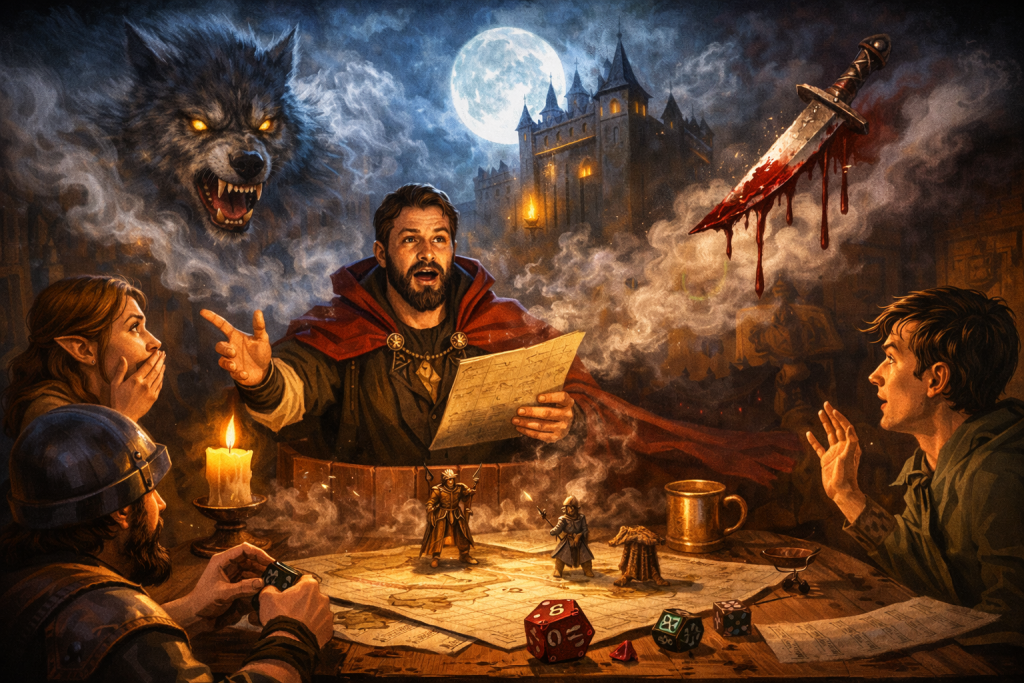
Even the most cavalier player is somewhat hardwired to protect their character. Without ever mentioning the “W” word, you can suggest that a pack of lycanthropes is nearby by describing the sour smell of wet fur, the distant howling on the wind, and the metallic taste of fear in the air.
Stat blocks are maths homework.
Sensations create memories.
Why Horror Games Especially Collapse
A flick through the bestiary of any given TTRPG will provide you with a menagerie of malignant monsters that would haunt the dreams of H. R. Giger, let alone the characters’ players. From the nightmarish Hook Horror in D&D to the humble but utterly repugnant Deep Ones of the Call of Cthulhu mythos, there is no shortage of creatures to haunt your players’ dreams.
The problem is rarely the monster; the problem is when you reduce this frightful abomination to a linear set of sums.
Horror games are a delicate balancing act for a GM. On the one hand, the game still has to be fun, engaging, and just challenging enough to keep players invested. On the other, you are trying to scare the stuffing out of them.
That means making the players just a little uncomfortable.
As a GM, you should encourage players to go beyond casually saying, “I run away.” Instead, describe what that feels like. The metallic taste of adrenaline in their mouth. The tightness in their chest as they struggle for breath. The burning ache in their legs as they sprint for their lives.
By the same token, the players have a role to play in bringing the horror to the table.
Rather than simply saying “Okay, I’m spooked,” think about what that actually looks like. Maybe your character talks too quickly. Maybe they laugh at the wrong moment. Maybe they refuse to turn their back on the dark hallway.
When GMs and players narrate outcomes instead of embodying reactions, tension evaporates.
The scene stops feeling dangerous.
It becomes mechanical.
Embodied play keeps the dread alive.
Practical Advice for Players
Although the GM is, ultimately, everyone and everything else in the game universe that isn’t represented by a warm body around the table, we all share some responsibility for helping to build the world, even if it is only the small piece of real estate that exists between our characters’ ears.
Any GM worth their dice bag will encourage players to play what their character is feeling.
(“EMOTE!” as my old drama teacher used to yell at us.)
One simple trick is to give each strong emotion a small physical detail. Do you clench your fists when the villain challenges your honour? Do you fiddle with your flight suit when the rebel leader gives an inspiring speech?
These little gestures might seem minor, but they give the GM and the other players something to react to. They turn an abstract emotion into something visible at the table.
Players can also help by encouraging the GM to use sensory details.
I once played a blind paladin. My GM at the time was excellent at visual descriptions, but my character forced him to think about the other senses. The result was that his games suddenly had an entirely new dimension.
And finally, whenever possible, show rather than tell.
Instead of saying, “I angrily walk away,” show us the big frost warrior with his shoulders hunched as he storms from the room.
Instead of “Leaf laughs at that,” actually suppress a chuckle at the table as your halfling rogue watches their latest hare-brained scheme go sideways.
Small signals like these bring characters to life. Put simply: If you name the emotion, ask yourself “what does that look like?”
Practical Advice for Game Masters
As GMs, we spend hours building the lore of our worlds. We pore over stat blocks and run through a dozen scenarios in our heads before we ever sit down at the table and unleash our story on our players. So after all that work, why let it collapse into a linear series of rooms filled with drab, by-the-numbers combat?
One useful rule of thumb is to include at least two senses in every scene, room, or encounter.
Think of the foul stench of unwashed bodies and the oppressive heat of an orc barracks. Or the soft music and scent of spring flowers drifting through an elven glade.
You can also use environmental clues instead of exposition. If an NPC fails their deception check, don’t simply say, “They’re lying.” Let the players figure it out. Maybe their eyes dart around the room. Their mouth dries up. Perhaps they start talking too quickly, giving far too much detail while carefully avoiding eye contact.
At the gaming table, nothing is less frightening than being told, “You are scared.” The natural response is usually something like: “No I’m not. I’m eating pizza and rolling dice with my friends.”
Instead, infer danger. A pile of grinning skulls outside the ogre’s cave. The smell of blood and wet fur on the wind. There are endless ways to signal danger without ever announcing it.
That’s not to say every encounter requires the same depth of description as a plot-critical scene. A random encounter with a pickpocket isn’t equal to something as emotionally weighty as a character’s mentor dying But that doesn’t mean it should be forgettable either. Give the pickpocket a name. A reason. A small detail that sticks in the players’ minds.
Finally, use NPC reactions to help telegraph the tone of a scene.
Does Strider, the normally dour ranger, crack a warm smile of recognition? Does Tri-Dum the Jedi finger the hilt of his lightsaber when the stormtroopers stop him to check his ID?
Often the easiest way to show players how they should feel about a situation is to let the NPCs demonstrate it first.
Chekhov once told writers not to tell readers the moon was shining, but to show them the glint of light on broken glass.
That’s good advice for novelists.
It’s even better advice for Game Masters.
Don’t tell your players the dungeon is scary.
Don’t tell them the villain is dangerous.
Don’t tell them the forest is cursed.
Let them hear the howling in the distance.
Let them smell the wet fur on the wind.
Let them notice the way the NPC suddenly stops smiling.
Because the moment players start feeling the world instead of just hearing about it…
That’s when the game truly comes alive.
May all your d20s be blessed
-RBD